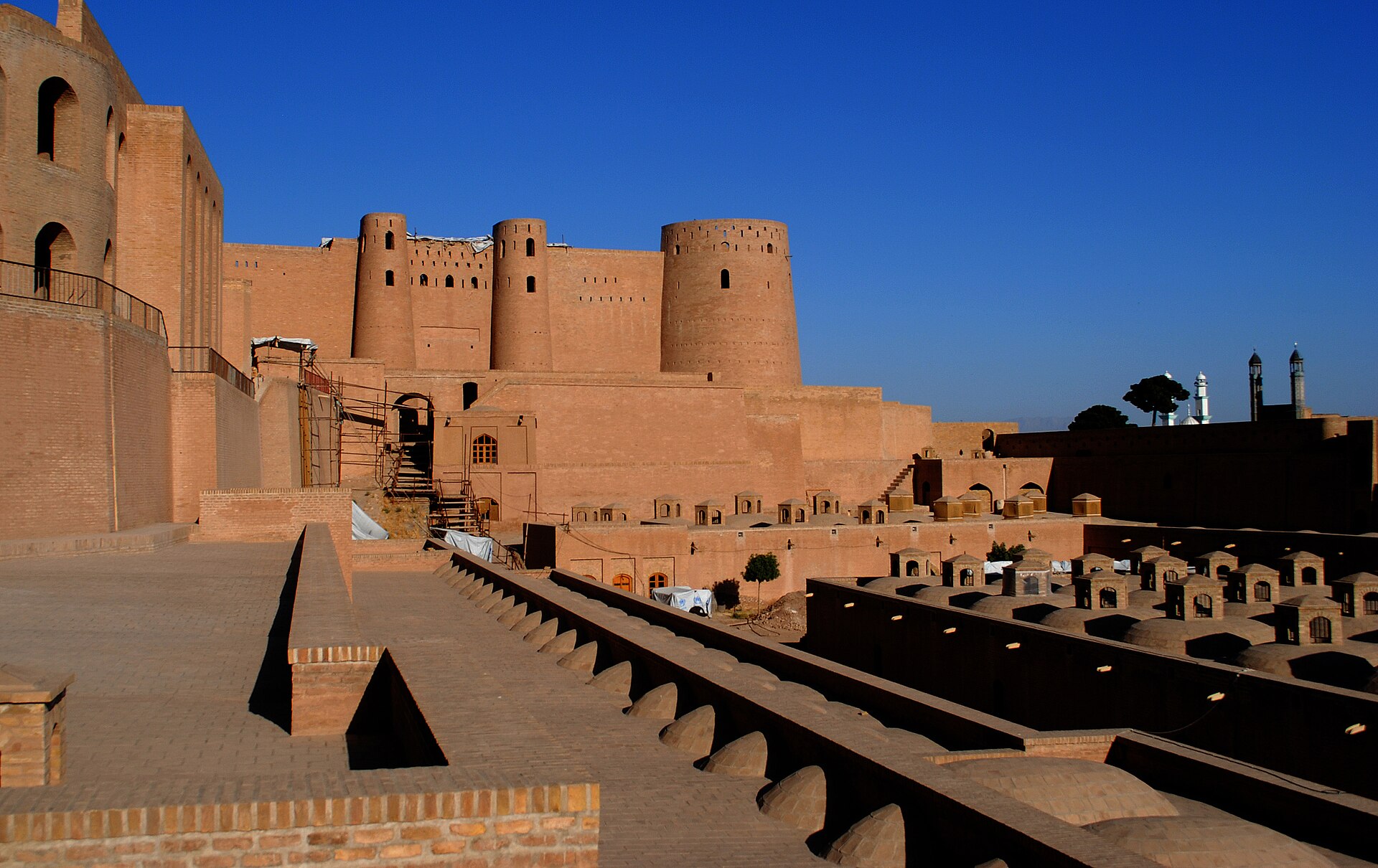
The Citadel of Herat has been rebuilt many times, reflecting the city’s long strategic and cultural importance. Its present walls and towers preserve layers of history rather than a single moment.
A city at a crossroads
Herat prospered on routes connecting Iran, Central Asia and the Indian subcontinent. Rulers invested in its defences, gardens, mosques and schools, making it a major centre of art and learning.
The citadel is commonly associated with Alexander the Great, although much of the visible structure belongs to later Islamic periods.
Restoration and memory
Modern conservation has stabilised large parts of the fortress and created space for exhibitions. The result offers a tangible introduction to Herat’s urban history.
A fortress repeatedly rebuilt
The citadel that dominates central Herat is commonly known as Qala Ikhtiyaruddin. Tradition connects the fortified site with Alexander the Great, but most visible fabric belongs to later periods and repeated reconstruction. Herat changed hands many times, and its defensive centre was repaired, expanded and adapted by successive rulers. It is therefore more accurate to read the citadel as layers of history than as one building preserved unchanged from antiquity.
Herat as a centre of learning and art
The city flourished especially under the Timurids in the fifteenth century. Architecture, manuscript painting, calligraphy, poetry and scholarship received courtly support, and Herat’s influence travelled far beyond the region. The citadel’s position within today’s city makes it a useful starting point for understanding that cultural landscape, which also includes mosques, shrines, gardens, bazaars and the surviving minarets of the Musalla complex.
Conservation and public memory
Major conservation work in the early twenty-first century repaired walls and towers and helped make parts of the complex accessible. Restoration must balance structural safety with clear evidence of different building phases. The citadel is also a civic landmark: residents see it as part of Herat’s identity, not merely an archaeological object. Any description should acknowledge both the uncertainty of its earliest history and the importance of its later Islamic architecture.
For heritage context, see UNESCO’s City of Herat tentative-list record.
Reading the evidence carefully
Some popular accounts call the citadel the “Citadel of Alexander”. That label reflects a broad tradition connecting Herat with Alexander’s campaigns; it should not be read as proof that the present walls date intact from the fourth century BCE.
Place names may have several accepted English spellings because Dari, Pashto and other languages use writing systems that do not map to English in only one way. Dates and attributions can also change as research develops. Afghan Desk prioritises UNESCO, institutional and scholarly reference material, labels local tradition as tradition, and avoids presenting a single photograph as a complete view.
Current access, conservation conditions and local rules may differ from the historical description here. Anyone planning travel should consult recent official advice and knowledgeable local sources. Sacred spaces, homes, farmland and working infrastructure deserve privacy and care; a meaningful visit begins with the rights of the people who use the place every day.