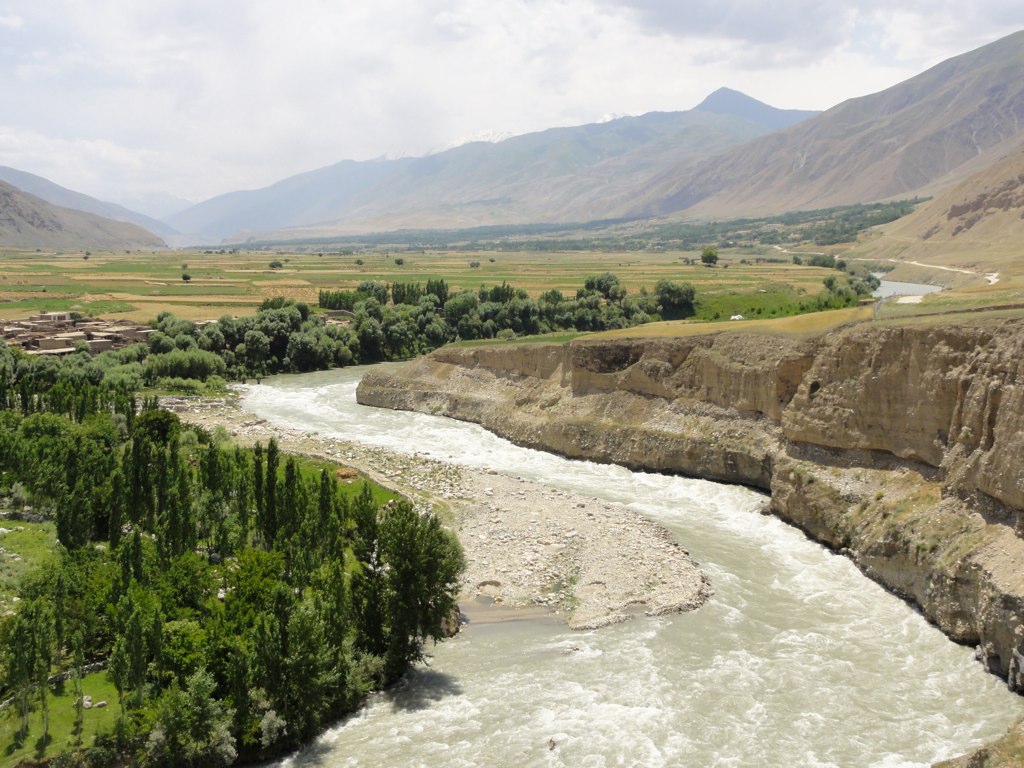
Fed by the mountains of northeastern Afghanistan, the Kokcha passes Fayzabad and links high valleys, cultivated land and settlements before joining the wider Amu Darya river system.
A river shaped by mountains
Seasonal snowmelt gives the river its changing character. Fields and rows of poplar and willow follow the water, forming green corridors against dry, steep slopes.
Badakhshan is also renowned for lapis lazuli. Stone from its mines travelled along ancient trade routes to distant parts of Asia, the Middle East and the Mediterranean.
More than a scenic view
The Kokcha helps explain how communities grow in a demanding mountain landscape. Water supports farming, connects settlements and turns narrow valleys into places of movement and exchange.
From the Hindu Kush to the Amu Darya
The Kokcha drains a large part of Badakhshan. Its headwaters rise among the high valleys of the Hindu Kush and Pamir region, and tributaries gather snowmelt and rain before the river passes close to Fayzabad. Farther north, the Kokcha joins the Amu Darya system. Like many Afghan rivers, its flow changes strongly with the seasons: spring and early summer snowmelt can swell the channel, while colder months bring lower water.
Water, settlement and farming
In a mountainous province, a river valley provides relatively level land, irrigation water and routes between settlements. Fields, orchards and rows of poplar or willow often mark these inhabited corridors. Water must be shared carefully because the same flow supports households, crops and animals downstream. Flooding and erosion can also threaten riverside land. The Kokcha is best understood not as scenery alone, but as working infrastructure created jointly by nature and generations of local water management.
Lapis lazuli and long-distance exchange
Badakhshan’s Sar-e-Sang mines are among the world’s famous historic sources of lapis lazuli. Archaeological finds show that the blue stone travelled far beyond the region in antiquity. The Kokcha valley formed part of the difficult network of paths through which mountain products, people and ideas moved. This does not mean that one simple “Silk Road” followed the river; it means the valley belonged to a much broader web of regional exchange.
Geographical background can be checked against the Encyclopaedia Britannica overview of the Kokcha River.
Reading the evidence carefully
Spellings such as Kokcha, Kowkcheh and Kökcha refer to the same river in different transliteration systems. They are clues about the languages and publication histories behind a source, not necessarily different geographical features.
Place names may have several accepted English spellings because Dari, Pashto and other languages use writing systems that do not map to English in only one way. Dates and attributions can also change as research develops. Afghan Desk prioritises UNESCO, institutional and scholarly reference material, labels local tradition as tradition, and avoids presenting a single photograph as a complete view.
Current access, conservation conditions and local rules may differ from the historical description here. Anyone planning travel should consult recent official advice and knowledgeable local sources. Sacred spaces, homes, farmland and working infrastructure deserve privacy and care; a meaningful visit begins with the rights of the people who use the place every day.