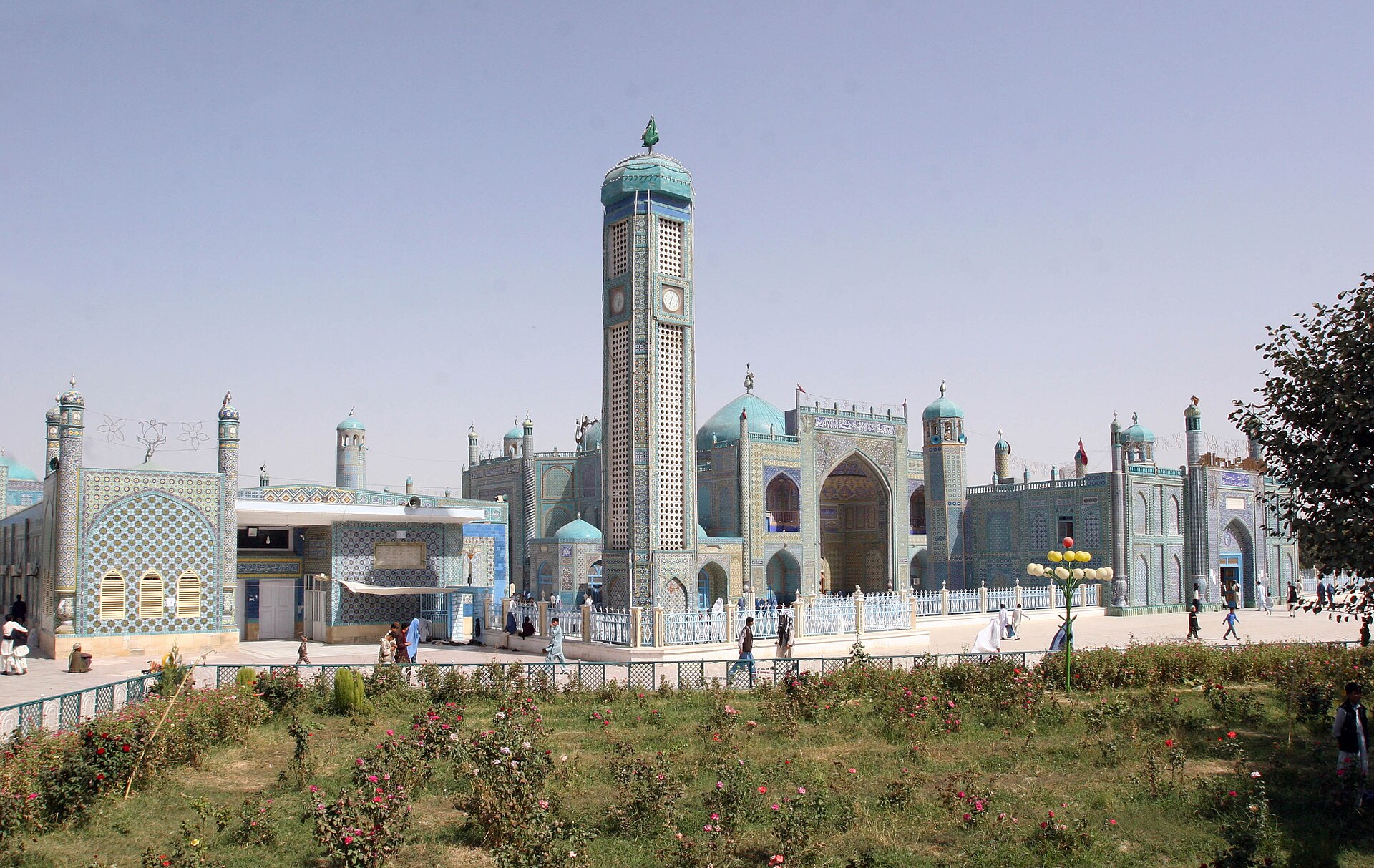
Mazar-e Sharif takes its name from the “noble shrine” at its centre. The complex is known for luminous blue tilework, broad courtyards and the white doves that gather around it.
The Blue Mosque
The shrine is traditionally associated with Ali, the cousin and son-in-law of the Prophet Muhammad. Other traditions place his burial in Najaf, Iraq; the Mazar site nevertheless holds deep devotional and cultural importance.
Intricate glazed tiles cover façades, domes and minarets in shifting patterns of blue, turquoise, white and yellow.
Spring and public life
The city is closely connected with Nowruz, the spring new year observed across the region. Public gatherings around the shrine have long marked the changing season.
The shrine at the city’s heart
Mazar-e Sharif means “Noble Shrine”. The city developed around the shrine commonly called the Blue Mosque, which many local traditions associate with Ali ibn Abi Talib, cousin and son-in-law of Prophet Muhammad (peace be upon him). Other Islamic traditions place Ali’s burial in Najaf, Iraq. It is respectful and accurate to describe the Afghan association as a deeply held local tradition rather than presenting a disputed location as settled fact.
Architecture and public space
The complex is known for brilliant blue tilework, courtyards, domes and changing patterns of repair. It is both a sacred place and a major urban gathering space. Worshippers, families and visitors share its gardens, while white doves have become a familiar part of its visual identity. Modest dress, quiet behaviour and sensitivity around prayer are appropriate; photography should never take priority over the dignity of worshippers.
Nowruz and northern Afghanistan
Mazar-e Sharif is widely associated with Nowruz, the spring new year celebrated across Afghanistan and a much broader region. Public observances have historically included the raising of a ceremonial standard, visits, food and family gatherings, although practices and public conditions change. The city is also an economic centre for northern Afghanistan, linked with Balkh and trade routes toward Central Asia. Its identity reaches well beyond a single monument.
Cultural context: UNESCO Intangible Cultural Heritage: Nowruz.
Reading the evidence carefully
The modern city and nearby ancient Balkh are closely connected but not interchangeable. Balkh contains remains from earlier urban periods, while Mazar-e Sharif grew around the shrine and became the principal regional city in more recent centuries.
Place names may have several accepted English spellings because Dari, Pashto and other languages use writing systems that do not map to English in only one way. Dates and attributions can also change as research develops. Afghan Desk prioritises UNESCO, institutional and scholarly reference material, labels local tradition as tradition, and avoids presenting a single photograph as a complete view.
Current access, conservation conditions and local rules may differ from the historical description here. Anyone planning travel should consult recent official advice and knowledgeable local sources. Sacred spaces, homes, farmland and working infrastructure deserve privacy and care; a meaningful visit begins with the rights of the people who use the place every day.